A company with a 3.2 Glassdoor rating sounds alarming. But before automatically eliminating it from consideration, it is worth understanding what that rating actually means — and when a low rating is genuinely predictive versus when it is misleading. Context is everything.
What Glassdoor Ratings Actually Measure
A Glassdoor rating is the average of self-selected employee reviews — weighted toward those with strong opinions. It does not measure:
- Actual day-to-day experience for the majority of employees
- Your specific team, manager, or role type
- The current culture (if the company has changed recently)
- Whether the job is right for your specific needs and values
When a Low Rating Is a Genuine Warning Sign
Consistent, Recent, and Specific
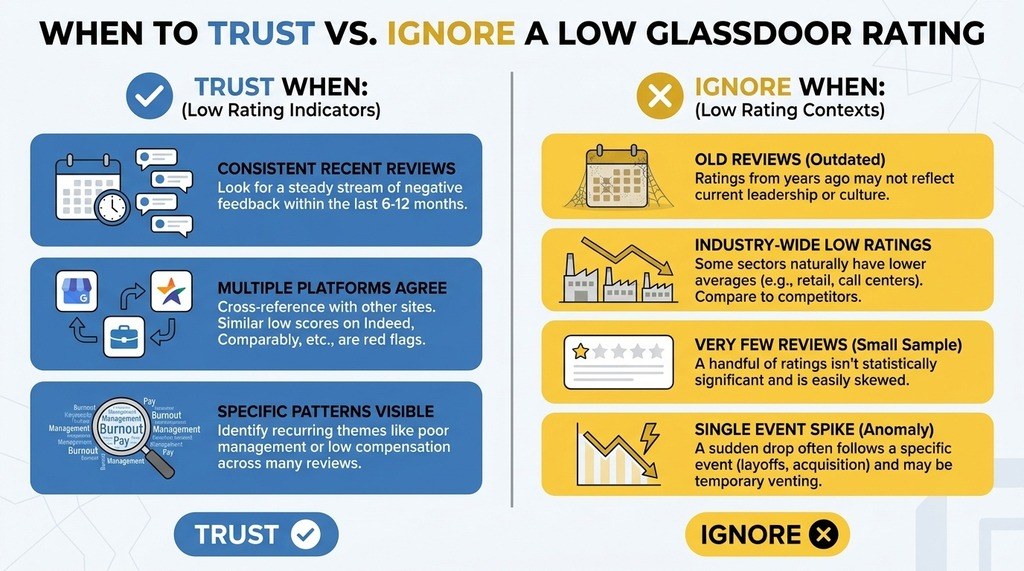
A 3.2 rating driven by recent, specific, consistent complaints across multiple reviewers from different departments is a genuine warning. If reviews from the past 12 months from engineering, marketing, and operations all describe the same management dysfunction — that is a pattern.
CEO Approval Below 60%
CEO approval below 60% is the single Glassdoor metric most correlated with genuine cultural problems. A low overall rating paired with low CEO approval suggests systemic leadership issues unlikely to resolve quickly.
Multiple Platform Alignment
When Glassdoor, Indeed, and Blind all show similar ratings and similar complaints — that multi-platform alignment is strong evidence. When only one platform shows a low rating, question the sample.
When a Low Rating May Be Misleading
The Industry Is Structurally Low-Rated
Retail (3.2–3.5 average), call centers (3.1–3.4 average), and fast food companies (2.8–3.3 average) are structurally lower-rated across entire industries. A 3.3 at a company leading its retail sector means something very different than a 3.3 in a tech sector where the average is 4.2.
The Low Rating Comes From a Specific Event
A sudden drop following a mass layoff or acquisition often reflects that event — not the steady-state culture. If the 2.8 reviews are concentrated in a 3-month window 2 years ago and recent reviews are 3.8+, the company may have genuinely improved.
Very Few Total Reviews
A company with 8 reviews and a 2.9 rating has essentially no statistical signal. Do not draw strong conclusions from any company with fewer than 50 reviews.
The 5-Step Low Rating Analysis Framework
- What is the industry average? Is this below industry par or just below 4.0?
- Are the critical reviews recent (last 12 months) or historical?
- How many total reviews exist? Is the sample meaningful?
- Is there a specific event explaining the rating?
- What do Indeed and Blind show? Is the rating consistent?
Conclusion
A low Glassdoor rating should trigger deeper investigation — not automatic elimination. Some of the best career opportunities hide behind imperfect ratings. Some of the most miserable working environments hide behind 4.2 stars. The number is the beginning of your research, not the end of it.