Most people have a vague sense of where they want their career to go — but vague ambitions rarely produce specific results. A five-year career plan is not a rigid script — it is a directional framework that helps you make decisions today that compound into significant progress over time. Here is how to build one that is realistic, motivating, and actually followed.
Why Most Career Plans Fail
Career plans fail when they are either too rigid (not accounting for how things change) or too vague (not specific enough to drive daily decisions). The best plans are flexible in approach but clear in destination. Think of it like GPS: if you take a detour, the GPS recalculates — but it never loses sight of where you are going.
Step 1: Define Your 5-Year Vision
Start with the end in mind. Where do you want to be in five years?
- What role or title do you want?
- What industry or company type?
- What income level are you targeting?
- What lifestyle do you want your work to support?
- What kind of work do you want to be doing daily?
Be specific. “Senior marketing manager at a B2B tech company earning $120,000 with two days remote” is a plan. “Something in marketing” is not.
Step 2: Identify the Gap
Now look honestly at where you are today. What is the gap between your current position and your 5-year vision? Map the specific gaps across:
- Skills you need to develop or deepen
- Experience you need to gain
- Credentials or certifications required
- Network connections you need in your target field
- Industries or company types you need exposure to
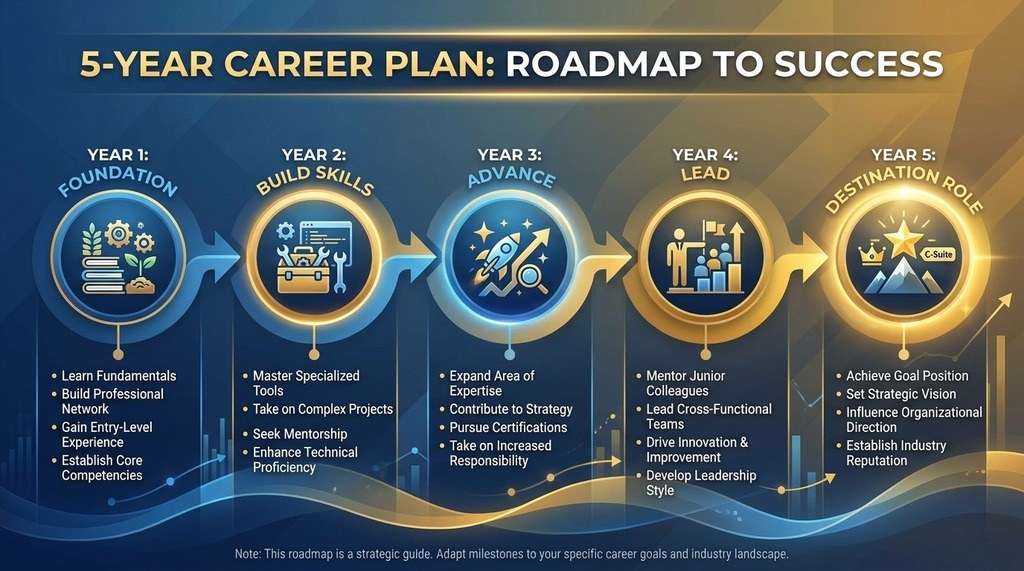
Step 3: Build a Year-by-Year Roadmap
Break your five-year vision into annual milestones. For each year, define:
- The role or stage you want to be at by year end
- The key skill or credential to acquire that year
- The key relationship or network development goal
- A measurable professional development goal
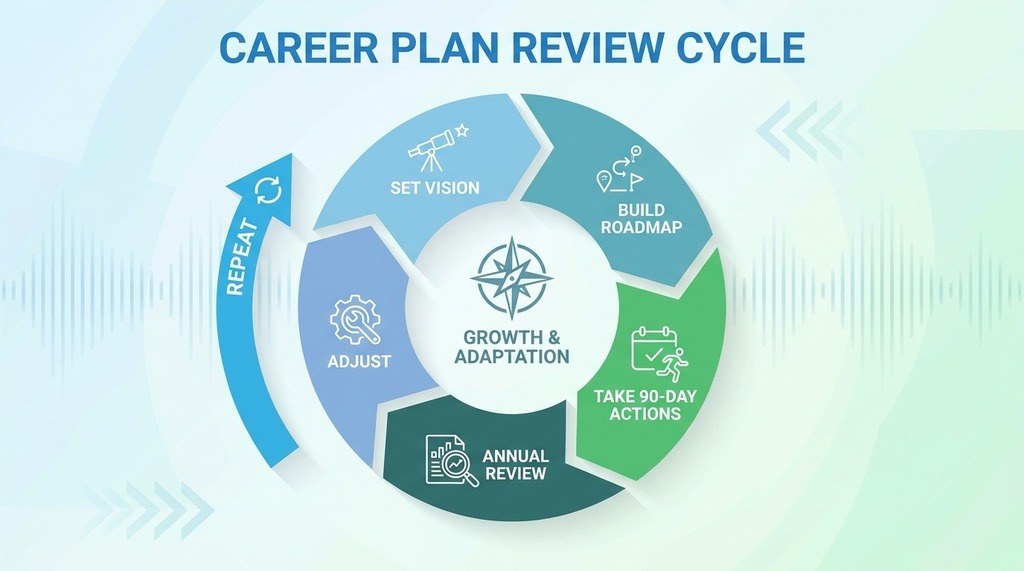
Step 4: Convert to 90-Day Actions
Five years is too far away to drive daily behavior. After mapping your yearly milestones, break your immediate year into 90-day sprints with specific, actionable goals. What are you doing this week that moves the needle toward your 5-year vision?
Step 5: Build in Flexibility
Review your plan annually and adjust for reality. Job markets change. New opportunities arise. Your values and interests evolve. A five-year plan that you refuse to update becomes a cage. One that you review and refine regularly becomes a compass.
Questions to Ask During Your Annual Review
- Am I on track to reach my 5-year vision? If not, why?
- Have my goals or values changed? Does my plan still reflect them?
- What worked this year? What did not?
- What single change would most accelerate my progress in the next year?
Conclusion
A five-year career plan is not a prediction — it is a commitment to intentional direction. The professionals who build and follow career plans do not always end up exactly where they planned — but they consistently end up further ahead than those who navigated by circumstance alone. Define your destination, map your route, and start walking. The path clarifies as you move.