Data science continues to be one of the most in-demand and well-compensated careers in the world. In 2026, with more data being generated than ever and AI tools expanding the capabilities of data teams, the demand for skilled data scientists shows no signs of slowing. Here is your complete roadmap to breaking into the field — even with no prior experience.
What Data Scientists Actually Do
Data scientists extract insights from large datasets to help organizations make better decisions. Typical responsibilities include:
- Collecting and cleaning messy real-world data
- Building statistical and machine learning models
- Communicating findings clearly to non-technical stakeholders
- Deploying models into production systems
- Continuous model monitoring and improvement
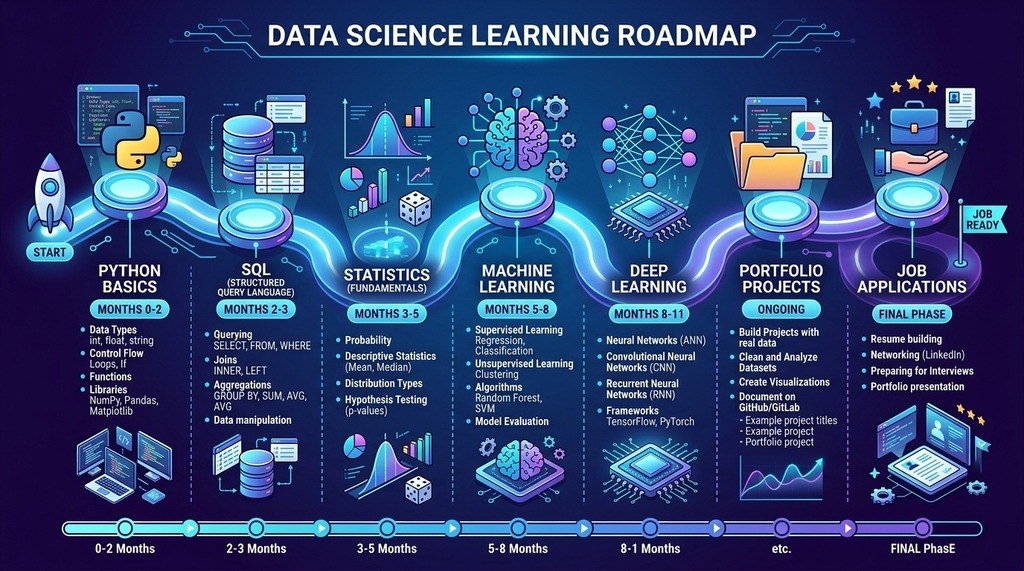
Step 1: Build Your Technical Foundation
The core technical stack every data scientist needs:
- Python — The primary language of data science. Start here before anything else.
- SQL — Every data scientist needs strong SQL skills to query and manipulate data.
- Statistics and probability — The mathematical backbone of data science. Understand distributions, hypothesis testing, and regression.
- Pandas and NumPy — Core Python libraries for data manipulation
- Matplotlib / Seaborn / Plotly — Data visualization
- Scikit-learn — Accessible machine learning library for beginners
Step 2: Learn Machine Learning Fundamentals
Once you have Python and statistics foundations, move into machine learning:
- Supervised learning: regression, classification, decision trees
- Unsupervised learning: clustering, dimensionality reduction
- Model evaluation: cross-validation, precision/recall, AUC-ROC
- Feature engineering and selection
- Intro to neural networks and deep learning (TensorFlow or PyTorch)
Step 3: Build Real Projects for Your Portfolio
A data science portfolio is your most important job search asset. Build 3–5 end-to-end projects that demonstrate:
- Real data collection and cleaning
- Exploratory data analysis with clear visualizations
- A modeling pipeline with justified choices
- Clear insights and recommendations
- Clean, documented code on GitHub
Good beginner project ideas: Predicting house prices, customer churn analysis, sentiment analysis of product reviews, recommendation systems.
Step 4: Get Certified
Respected data science certifications in 2026:
- Google Professional Data Analytics Certificate (Coursera)
- IBM Data Science Professional Certificate (Coursera)
- DataCamp Data Scientist track
- AWS Certified Machine Learning Specialty (for ML engineers)
- TensorFlow Developer Certificate (Google)
Step 5: Apply Strategically
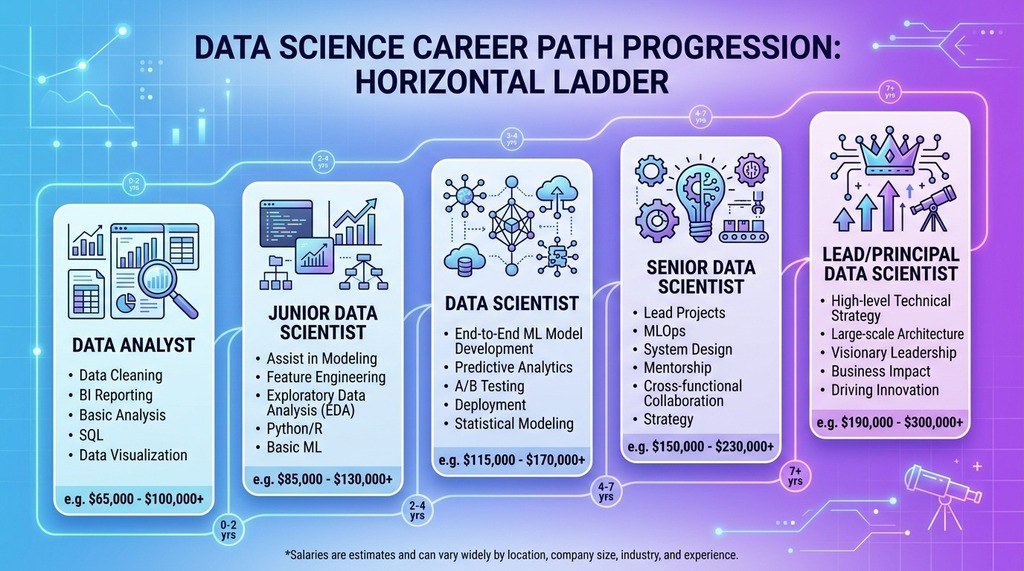
Start with junior or analyst-level roles: “Data Analyst,” “Junior Data Scientist,” “Business Intelligence Analyst,” or “ML Operations Analyst.” These are legitimate entry points that lead to senior data science roles. Be realistic about the first role — the progression from there is fast for strong performers.
What Salaries Look Like
- Junior Data Scientist: $70,000 – $110,000
- Mid-Level Data Scientist: $110,000 – $160,000
- Senior Data Scientist: $150,000 – $220,000+
- Lead/Principal Data Scientist: $200,000 – $350,000+ (at top tech firms)
Conclusion
Breaking into data science in 2026 is absolutely achievable without a data science degree — if you build the right skills systematically, create real projects that demonstrate your abilities, and apply consistently to the right roles. The learning journey is genuinely exciting: every new technique you master makes you more capable of extracting meaning from the world’s most valuable resource — data.