Giving two weeks notice is one of the most professionally significant emails you will ever send. Do it well and you protect relationships, your reputation, and your reference list. Do it poorly and you risk burning bridges that took years to build. Here is everything you need — including ready-to-use templates.
Should You Give Two Weeks or More?
Two weeks is the standard minimum in most industries. However, consider giving more notice if:
- You are in a senior or highly specialized role that is hard to backfill
- You are in the middle of a critical project
- Your contract specifies a longer notice period
- You genuinely want to leave on excellent terms
Giving more notice than required is a reputation-builder. It is a low-cost, high-value professional gesture.
When to Send the Email
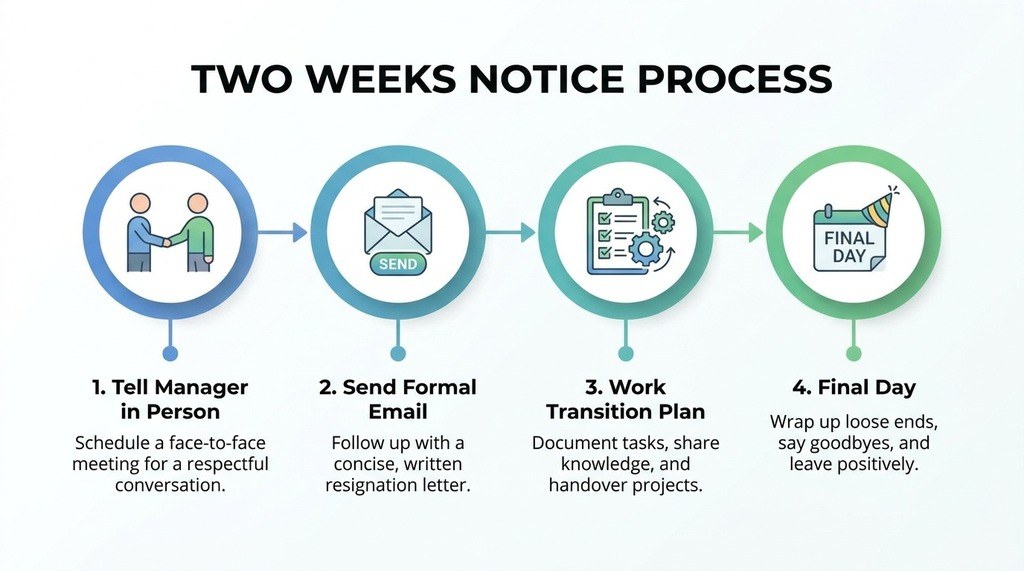
Always have the in-person (or video call) conversation with your direct manager before sending the email. The email confirms and documents what was discussed — it should never be the way your manager finds out you are leaving. Send it immediately after that conversation.
Template 1: Standard Two Weeks Notice Email
Subject: Resignation — [Your Name] — [Job Title]
Dear [Manager’s Name],
I am writing to formally notify you of my resignation from my position as [Job Title] at [Company Name], effective [Last Day — two weeks from today’s date].
This was not an easy decision. I have genuinely valued my time here, and I am grateful for the opportunities you and the team have given me to grow professionally. I am particularly proud of [specific achievement or project].
I am committed to making this transition as smooth as possible. I am happy to assist with handover documentation, training a replacement, or completing any outstanding work before my final day.
Thank you again for everything. I hope we can stay in touch.
Warm regards,
[Your Name]
Template 2: Short and Professional (Minimal Version)
Subject: Notice of Resignation — [Your Name]
Dear [Manager’s Name],
Please accept this letter as formal notice of my resignation from [Company Name], effective [Last Working Day].
Thank you for the opportunity to be part of the team. I will do everything I can to support a smooth transition before my final day.
Best regards,
[Your Name]
Template 3: When Leaving Under Difficult Circumstances
Even if you are leaving because of poor management, toxic culture, or burnout — keep the email professional. Never detail grievances in a resignation email. A neutral exit protects your reference and reputation.
Subject: Resignation — [Your Name]
Dear [Manager’s Name],
I am writing to formally resign from my position as [Job Title], with my last working day being [Date].
I appreciate the experience I have gained during my time here and wish the team continued success. I will ensure all ongoing work is properly documented and handed over before I leave.
Regards,
[Your Name]

What to Do During Your Two Weeks
- Document all your processes, passwords, and ongoing projects
- Train your replacement or write a thorough handover guide
- Tie up or clearly hand off all open tasks
- Stay professional and engaged right to the last day
- Say genuine goodbyes and connect on LinkedIn with valued colleagues
What NOT to Do During Your Notice Period
- Do not check out mentally — your reputation through the last day matters
- Do not badmouth the company to colleagues
- Do not take confidential documents or client data
- Do not accept a counter-offer without very careful consideration (most people who accept them leave within 6 months anyway)
Conclusion
Your resignation email is a professional document that will be on file. Keep it gracious, brief, and forward-looking. How you leave a job is remembered long after what you accomplished there — make your exit as impressive as your tenure.