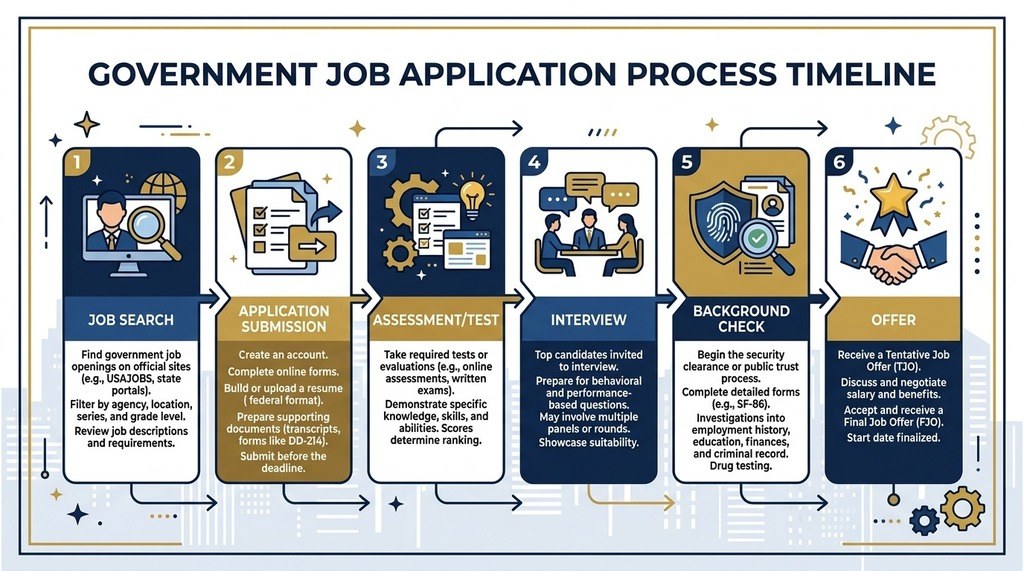
Government jobs offer exceptional job security, strong benefits packages, generous pension schemes, and work-life balance that private sector roles rarely match. In 2026, with economic uncertainty creating job market volatility, public sector employment has never been more attractive. Here is how the application process works — and how to navigate it successfully.
Why Government Jobs Are Worth Pursuing
- High job security — public sector layoffs are rare
- Comprehensive benefits: health insurance, retirement plans, paid leave
- Defined career progression with clear salary scales
- Meaningful work contributing to public services
- Strong work-life balance and flexible working policies
How Government Hiring Differs From Private Sector
Government hiring processes are typically:
- Longer: 3–6 months from application to start date is common
- More structured: Merit-based, with formal scoring criteria
- More transparent: Salary grades and progression are often published
- More administrative: Background checks, security clearances, and extensive paperwork are standard
Where to Find Government Jobs
- USA: USAJOBS.gov — the official federal jobs portal
- UK: Civil Service Jobs (civilservicejobs.service.gov.uk)
- Canada: Jobs.gc.ca
- Australia: APSJobs.gov.au
- State/Local government: Each has its own job portal — search “[your state/region] government careers”
How to Write a Strong Government Application
Government applications are heavily focused on competency-based selection criteria. Each application typically asks you to demonstrate specific competencies with concrete examples. Use the STAR method (Situation, Task, Action, Result) for every competency response.
Key tips:
- Address every selection criterion directly — do not assume reviewers will infer
- Use exact language from the job posting where possible
- Quantify results in your examples wherever you can
- Follow all formatting and length instructions precisely
Government Assessment Centers and Tests
Many government roles require passing standardized tests — numerical reasoning, verbal reasoning, situational judgment, or written exercises. Practice with official sample tests (most government portals provide them). For senior roles, assessment centers with group exercises and presentations are common.
Security Clearances
Some government roles require security clearance — a background check that evaluates your financial history, criminal record, character, and loyalty. This process can add months to the hiring timeline. Honesty in all declarations is essential — inconsistencies, not past issues, are most likely to cause problems.
Conclusion
Government careers are slower to enter than private sector roles, but they offer remarkable long-term stability and benefits. Start your search early, tailor every competency response meticulously, and prepare thoroughly for assessments. The process is demanding — the reward is a career built on a rock-solid foundation.